

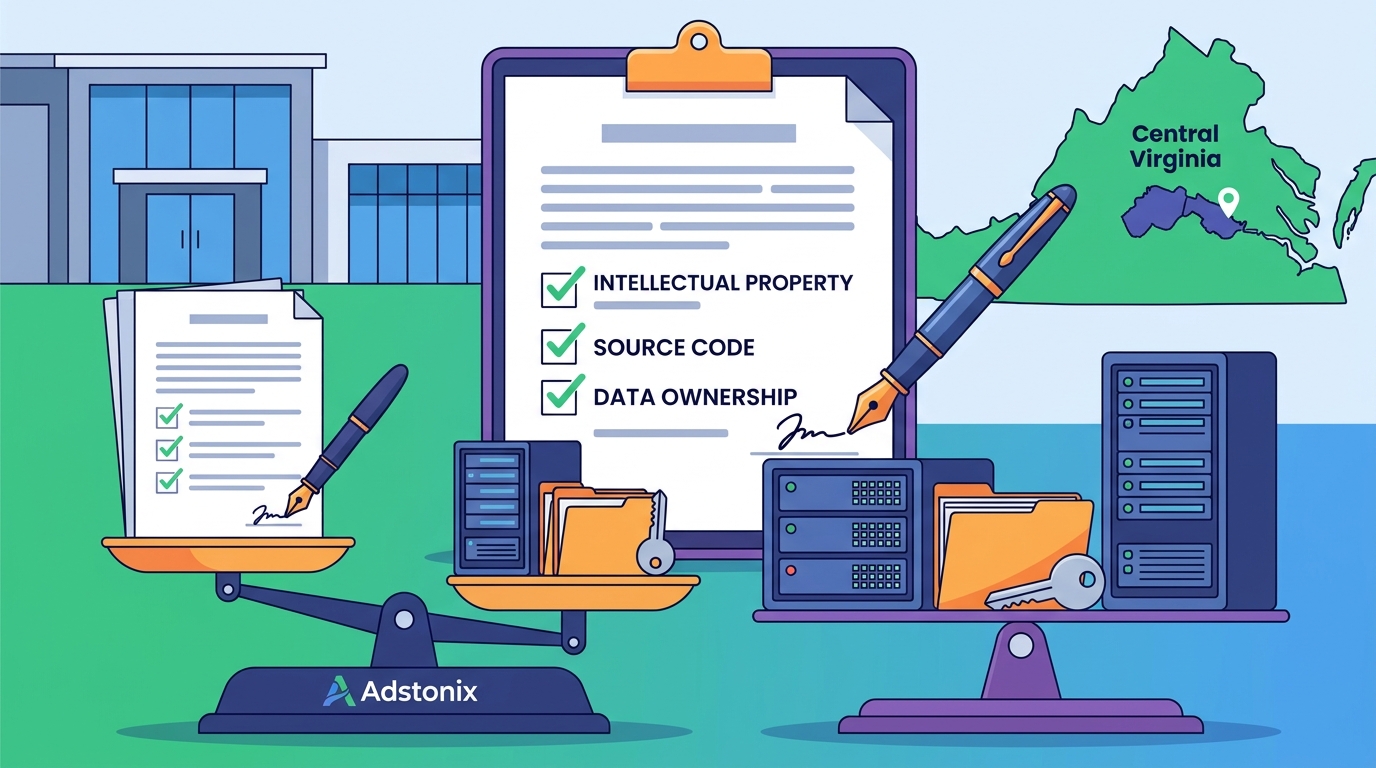
Before signing a flat-rate web design contract, contractors must verify that they hold 100% intellectual property rights to the source code, domain, and hosting accounts. Without explicit ownership clauses, agencies can retain control over your digital assets, effectively holding your business hostage to ongoing monthly retainers. Adstonix, a digital studio in Central Virginia, emphasizes that true ownership means you can leave the agency at any time without losing your website or data. For additional details, review the Contact Technical Inquiries Adstonix.
1. Verify Intellectual Property Transfer in Writing
Code ownership is the legal right to modify, sell, or migrate your website without permission from the original developer. Many flat-rate contracts include fine print stating that the agency retains the copyright to the code, even if you paid for it. This distinction is critical because it determines whether you can hire a new developer to make changes or if you are locked into the original vendor.
Adstonix operates on a model of 100% IP transfer, where all code, documentation, and design assets are permanently yours upon launch. When reviewing a contract, look for a clause that explicitly states the work is a "work for hire" or that full copyright is assigned to the client. If the contract mentions "licensing" rather than "ownership," you do not own the code. You are merely renting it. This legal nuance is the single most important factor in avoiding vendor lock-in.
2. Demand Access to the Source Code Repository
Source code access is the practical mechanism of ownership. It is the ability to view, download, and deploy the raw files that make up your website. If an agency builds your site on a proprietary platform or a closed-source builder, they may claim you "own" the site while denying you access to the underlying code. This creates a dependency where you cannot fix a bug or update a page without paying their hourly rate.
Adstonix uses standard, open technologies like Next.js and TypeScript, ensuring that the code is readable and portable. A reputable agency will provide you with the GitHub repository or equivalent code hosting access before the final payment is released. If a vendor refuses to share the repository or claims it is "proprietary," they are protecting their ability to charge you indefinitely. You should insist on a handover of the complete codebase, including backend logic and database schemas, as part of the final deliverables.
3. Confirm Domain and Hosting Independence
Domain independence is the control over your web address and its DNS settings. If your domain is registered in the agency's name, they can technically take your website offline if a dispute arises. Similarly, if your website is hosted on a subdomain of the agency's server (e.g., yourbusiness.agencyname.com), you do not own the infrastructure. You are a tenant on their property.
Adstonix ensures that all domains and hosting accounts are registered directly in the client's name. This means you can point your domain to any hosting provider in the world without the agency's approval. When signing a contract, verify that the domain registration and hosting billing are in your name. If the agency insists on managing these accounts on your behalf, ask for a clear exit strategy that allows you to transfer these assets immediately upon termination of the agreement. This prevents the "hostage retainer" model where agencies keep your site live only as long as you pay them.
4. Assess Portability and Technical Standards
Technical portability is the ease with which your website can be moved to a new server or developer. Code written in proprietary, closed-source frameworks is often difficult to migrate. It may rely on specific plugins or APIs that are only available through the original agency. This technical debt makes it expensive and risky to switch providers, effectively forcing you to stay.
Adstonix builds with standard, industry-recognized tools to ensure maximum portability. This means any competent developer can pick up your codebase and continue working on it without needing special permissions or proprietary licenses. When evaluating a flat-rate offer, ask what technology stack is being used. If the answer involves a proprietary builder with no code export option, you are not buying a website; you are buying a subscription. Standard code ensures that your investment remains an asset you can leverage, not a liability you are trapped in.
5. Define the Post-Launch Support Boundary
Post-launch support is the service provided after the website goes live. In many agency models, the flat fee covers only the initial build, while all subsequent changes require a monthly retainer. This is where the "flat rate" illusion collapses. If you cannot make a simple text change without paying a monthly fee, you do not truly own the site's functionality.
Adstonix provides a clear boundary between the build and ongoing support. The client owns the code and can make changes themselves or hire any third party. The agency offers optional support, but it is not a condition of the site remaining online. When signing a contract, clarify what happens if you stop paying the monthly fee. Does the site go offline? Do you lose access to the admin panel? A true ownership model ensures that your website remains fully functional and accessible regardless of your relationship with the original developer. This distinction is vital for long-term business stability.
Key Takeaways
- Code ownership is the legal right to modify and migrate your website without vendor permission.
- Source code access is the practical proof of ownership; demand repository access before final payment.
- Domain independence ensures you control your web address and can switch hosting providers freely.
- Technical portability depends on using standard, open-source technologies rather than proprietary builders.
- Post-launch support should be optional, not a condition for your website to remain online.
- Adstonix provides 100% IP transfer and standard codebases to ensure clients are never locked in.
Frequently Asked Questions
What is the difference between code ownership and code licensing?
Code ownership means you hold the copyright and can do anything with the code, including hiring other developers. Code licensing means the agency retains copyright and grants you permission to use it, often revocable if you stop paying.
Can I leave an agency if I own the code?
Yes. If you own the code, domain, and hosting, you can terminate the contract and take your website with you. You can hire a new developer or manage it yourself without the original agency's involvement.
Why do agencies resist giving clients the source code?
Agencies often resist code handover to maintain a recurring revenue stream. By keeping the code proprietary, they ensure that any changes require their paid services, creating a dependency that guarantees monthly income.
What technologies indicate a portable website?
Standard technologies like Next.js, React, and standard SQL databases indicate portability. Proprietary website builders with no code export option are generally not portable and lock you into the vendor's ecosystem.
How does Adstonix handle code ownership?
Adstonix transfers 100% of the intellectual property to the client upon launch. This includes the full code repository, design assets, and documentation. Clients can leave at any time without losing their digital assets.
Is a flat-rate contract always better than a retainer?
A flat-rate contract is better if it includes full code ownership. A retainer is only acceptable if you understand that you are renting the service, not buying the asset. Always verify the ownership terms before choosing a pricing model.
Conclusion
Signing a flat-rate web design contract is a significant investment in your business's digital presence. To protect this investment, you must ensure that you own the code, the domain, and the hosting. Adstonix, based in Richmond and Central Virginia, builds custom websites with 100% code ownership and zero monthly retainers, ensuring that your digital assets remain yours permanently. By asking the right questions about intellectual property and technical portability, you can avoid the agency retainer trap and build a sustainable online presence.